Issue 5

Related Links
1

Implementing a programme to treat severe acute malnutrition in Indonesia: What works?

▪ Author : Moretta D. Fauzi, Marinka van der Hoeven, Damayanti D Soekarjo, Rivani Noor, Iin Nurlinawati, Frank T Wieringa, Puspo Edi Gi-riwono
▪ Keyword : severe acute malnutrition, Indonesia, management, RUTF, guidelines
▪ Content : Background and Objectives: Indonesia, a middle-income country with a large population of young children, is predicted to have a demographic bonus in 2045. However, to benefit from this bonus, the government must optimal-ly manage the triple burden of malnutrition to prevent long-term effects that can significantly decrease quality of life. National data in 2023 showed an increased prevalence of acute malnutrition compared to previous years, a wake-up call for the government to address important contributing factors. This article aims to identify the current position of Indonesian guidelines on acute malnutrition (AM) and to provide recommendations. Methods and Study Design: A document analysis was conducted to examine the existing guidelines for the treatment of acute malnutrition in ...
2

Enteral nutrition intolerance: Evidence mapping of definitions and assessment practices to inform future gastric cancer–specific assessment tool development

▪ Author : Wei Fu, Qinchen Xu, Rong Zhang, Chunjuan Liu, Xiaodong Wang
▪ Keyword : enteral nutrition intolerance, gastric cancer, evidence mapping, assessment tool, enteral nutrition
▪ Content : Background and Objectives: Enteral nutrition intolerance can limit achievement of nutrition goals, but its defini-tions and assessment methods vary widely. This review mapped operational definitions and identified evidence gaps relevant to patients after gastrectomy for gastric cancer. Methods and Study Design: The Web of Science Core Collection was searched for original clinical studies published from 2015 to 2025 that reported explicit operational definitions or ascertainment criteria. Study populations, feeding routes, assessment components, incidence rates, and outcomes were charted and synthesized descriptively.
3

Effect of a walnut-based low carbohydrate diet on fat redistribution and visceral fat accumulation in people with central obesity: A randomized controlled trial

▪ Author : Qingqing Dong, Xiaohan Tan, Ping Feng, Qianqian Tian, Qing Jiang, Xiaohua Wang, Lili Wang
▪ Keyword : low carbohydrate diet, walnut, fat redistribution, visceral fat accumulation, central obesity
▪ Content : Background and Objectives: The aim of this study was to determine whether a walnut-based low carbohydrate diet (w-LCD) promotes fat redistribution and reduces visceral fat accumulation in people with central obesity (CO). Methods and Study Design: This study was a 12-week prospective randomized controlled trial. CO participants were recruited and assigned to the w-LCD group or high-carbohydrate, low-fat diet (HCD) group. According to "2021 Guidelines for Medical Nutrition Therapy of Overweight and Obesity", the HCD program was constructed; based on the HCD program, the w-LCD program was formed by replacing 150 grams/day of staple food with wal-nuts rich in healthy fat. The visceral fat area (VFA), trunk to leg fat ratio (TLR), and waist-to-hip ratio (WHR) were assessed at baseline and...
4

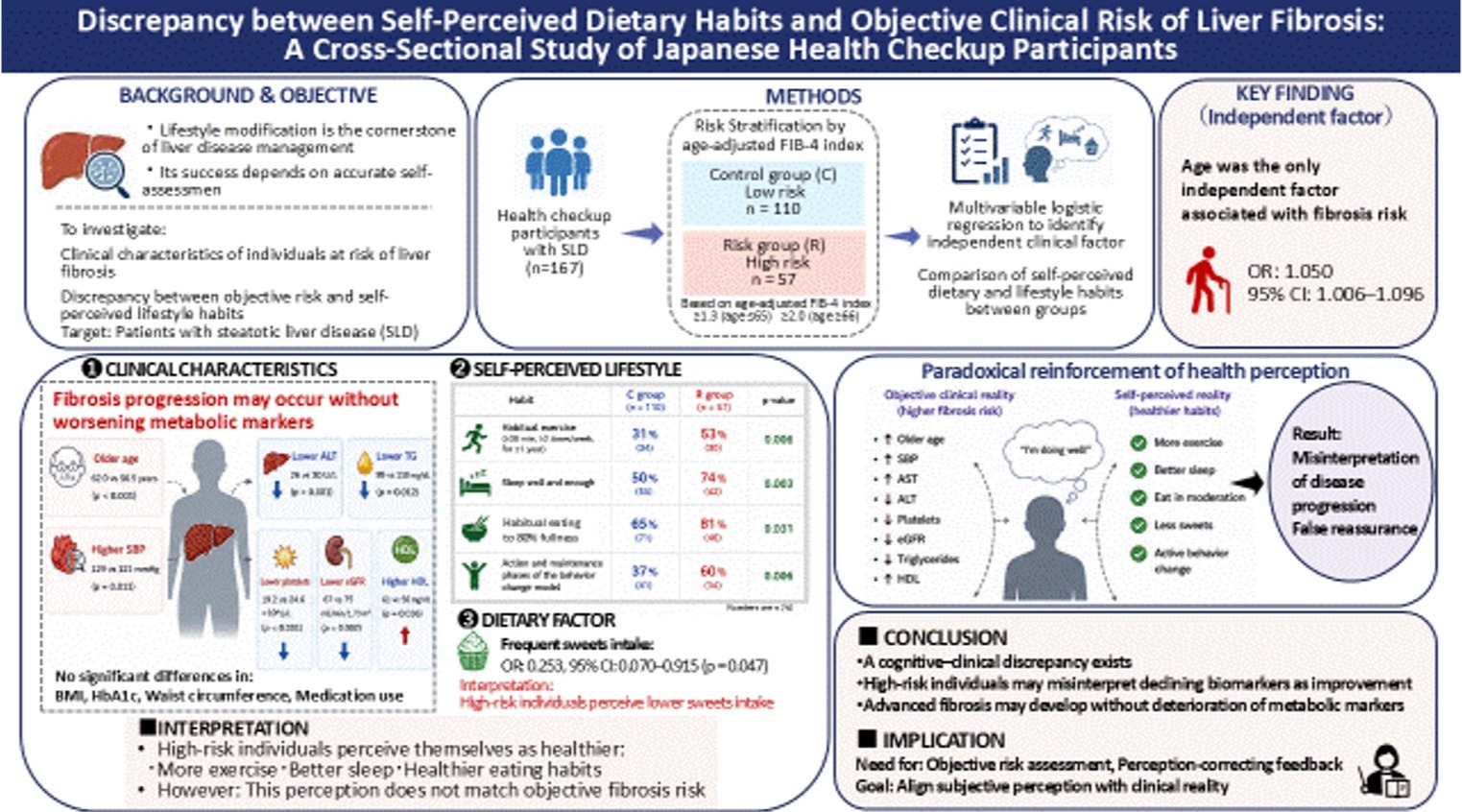
Discrepancy between self-perceived dietary habits and objective clinical risk of liver fibrosis: A cross-sectional study of Japanese health checkup partici-pants

▪ Author : Nao Kawabata, Naoki Morimoto, Mizuho Shimada, Shizukiyo Ishikawa, Kentaro Kurashina
▪ Keyword : liver fibrosis, Fibrosis-4 index, self-perception, dietary habits, weight management
▪ Content : Background and Objectives: Lifestyle modification is the cornerstone of liver disease management; however, its success depends on accurate self-assessment. We investigated the clinical characteristics of individuals at risk of liv-er fibrosis and the discrepancy between their objective risk and self-perceived lifestyle habits in patients with steatot-ic liver disease. Methods and Study Design: This cross-sectional study included 167 participants diagnosed with steatotic liver disease. Participants were categorized into a high-risk group (n = 57) and a control group (n = 110) based on the age-adjusted Fibrosis-4 index cutoffs. Multivariable logistic regression was used to identify independ-ent factors, and self-perceived habits were compared to evaluate cognitive–clinical discrepanc...
5

Mapping the scientific research on geriatric nutritional assessment (2016–2025): A bibliometric analysis

▪ Author : Lihua Ge, Yan Zhang, Ruxue Yan, Junli Zhou, Zhicui Yao
▪ Keyword : geriatric nutritional assessment, bibliometrics, population aging, malnutrition, healthy aging
▪ Content : Background and Objectives: Nutritional assessment is a crucial strategy for preventing and managing geriatric syndromes. This study conducted a bibliometric analysis to clarify the research trajectory and evolutionary trends in geriatric nutritional assessment, identify its core research characteristics and cutting-edge directions, and provide an academic reference for research and clinical practice. Methods and Study Design: A literature search was con-ducted in the Web of Science Core Collection and Scopus databases on January 7, 2026, limited to English-language original research articles and reviews on geriatric nutritional assessment published between 2016 and 2025. 1725 documents from Web of Science Core Collection and 4458 from Scopus were finally included, and quantita-tively ...
6

Construction of risk prediction models for psoriasis based on 45 dietary nutrients using machine learning and SHAP analysis

▪ Author : Xin Zhang, Zhe Gao, Jiang-Feng Feng, Xin-Gang Wu
▪ Keyword : psoriasis, dietary nutrient, machine learning, XGBoost, predictive model
▪ Content : Background and Objectives: To develop and validate a machine learning model to predict the risk of psoriasis based on 45 dietary nutrients. Methods and Study Design: 12,749 participants from the National Health and Nu-trition Examination Survey from 2009-2014 were included and their demographic, lifestyle, health status, and die-tary nutrient-related information is collected. Imbalanced data were processed using the synthetic minority over-sampling technique (SMOTE). After removing the covariate features, important features were further screened us-ing the Boruta algorithm and six machine learning models were constructed including Random Forest (RF), Light Gradient Boosting Machine (Light GBM), Kernel K-Nearest Neighbor (K-KNN), L Naive Bayes, Support Vector Machine (SVM) and Extreme ...
7

Inverse correlation between plasma 3-chlorotyrosine and pinch strength in chronic kidney disease patients

▪ Author : Liufu Ren, Shuhuan Hu, Lin Liu, Yun Liu, Chunlei Li, Huimin Hu, Lin Mi, Rongshao Tan
▪ Keyword : chronic kidney disease, sarcopenia, myeloperoxidase, 3-chlorotyrosine, muscle strength
▪ Content : Background and Objectives: This cross-sectional study aimed to explore whether plasma myeloperoxidase (MPO) and its active product, 3-chlorotyrosine (3-CT), as markers of inflammation and oxidative stress, have any inde-pendent pathophysiological association with sarcopenia-related parameters in patients with chronic kidney disease (CKD). Methods and Study Design: A total of 292 patients, including 147 on maintenance hemodialysis (HD) and 145 non-dialyzed hospitalized patients with CKD stages 1-5, were enrolled from September 2022 to December 2023 and categorized into three groups: CKD stages 1-2, CKD stages 3-5 (non-dialysis), and CKD stage 5 (HD). Clinical data, anthropometric measurements, and body composition via bioelectrical impedance analysis were col-lected.

8

Associations of percentage body cell mass with insulin resistance and type 2 diabetes: mediation effect of body mass index

▪ Author : Yan Wang, Qiang Lu, Lei Zhang, Guimei Wei, Xueyan Shen, Yan Peng
▪ Keyword : body mass index, insulin resistance, mediation analysis, percentage body cell mass, type 2 diabetes
▪ Content : Background and Objectives: Type 2 diabetes (T2D) stems from metabolic dysregulation, and body cell mass (BCM) comprises the principal physiological substrate of basal metabolic rate (BMR); however, the association be-tween BCM and diabetes is still unclear. This study examined the relationship of percentage body cell mass (PBCM) with insulin resistance (IR) and T2D, and evaluated the mediators of this association. Methods and Study Design: This study utilized data from U.S. adults in the National Health and Nutrition Survey (1999–2004). Weighted mul-tivariate regression, restricted cubic spline analysis, subgroup analyses, and sensitivity analysis were employed to investigate the relationship of PBCM with T2D risk biomarkers, IR and T2D.
9

Iron status from diet and serum in relation to biologi-cal aging acceleration: A NHANES cross-sectional study

▪ Author : Qiancheng Cao, Yujie Feng-Gao, Yanan Chen, Wei Li, Chuanshi Hu, Yifei Cao, Xiao Yan, Rong Chen, Xianrong Xu, Fuzhi Lian
▪ Keyword : iron status, biological aging, age acceleration, NHANES, serum iron
▪ Content : Background and Objectives: Iron is essential but potentially toxic; both deficiency and overload may affect aging. Population-level evidence linking iron exposure to biological aging is limited, and aging-based optimal iron ranges are undefined. We examined associations of total, dietary, and supplemental iron intake and serum iron with three biological age (BA) measures and derived optimal ranges. Methods and Study Design: We analyzed 13,284 U.S. adults (≥20 years) from NHANES 2007–2010 and 2015–2018. BA deviations (PA, GoldBA, LightBA) were de-rived from clinical biomarkers.
10

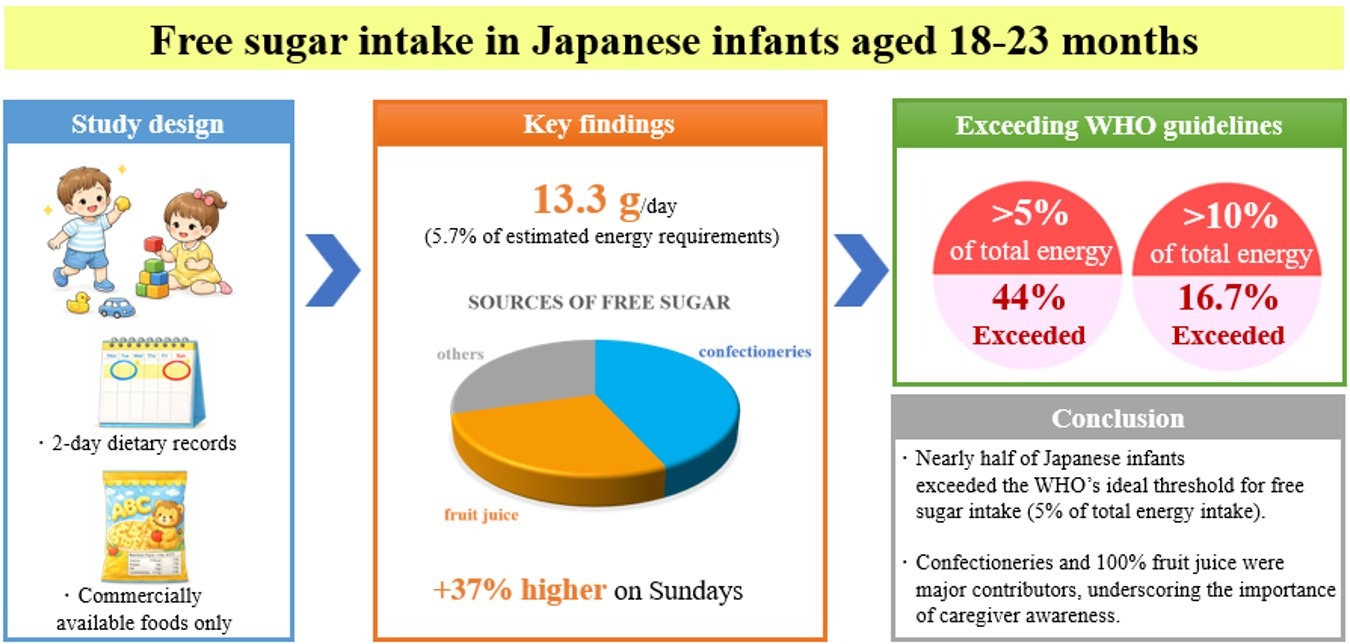
Free sugar intake and dietary sources in rural Japa-nese infants aged 18–23 months

▪ Author : Yohei Horikawa, Shuichi Yatsuga, Yuki Okamatsu
▪ Keyword : dietary sugars, Japan, infant, caregivers, feeding behavior
▪ Content : Optimizing sugar intake during early childhood is critical for preventing noncommunicable diseases. Although in-ternational guidelines recommend limiting free sugar intake, Japan is yet to consolidate data on free sugar intake among children under 2 years of age. This study examined free sugar intake, dietary sources, and associated factors among Japanese children aged 18–23 months. Methods and Study Design: A cross-sectional study was conduct-ed among children attending infant health checkups in Kama City, Japan. Caregivers recorded two non-weighed die-tary records (one weekday and one Sunday). Free sugar intake, dietary sources, and related factors were analyzed.
Copyright  APJCN. All rights reserved.