Issue 3

Related Links
1

Cultural adaptations of food exchange lists: A scoping review of applications in non-communicable disease management

Author : Safa Abdul Majeed, Ala Al Rajabi, Reema Tayyem
Keyword : food exchange lists, global health concerns, non-communicable diseases
Content : Background and Objectives: Non-communicable diseases (NCDs), including diabetes, cardiovascular diseases, and obesity, remain major global health challenges largely driven by suboptimal dietary patterns. The Food Exchange List (FEL) is a structured dietary planning tool originally developed for diabetes management to support balanced nutrient intake. Although FELs are widely used across diverse cultural and clinical contexts, evidence regarding their direct role in NCD prevention and management is limited. This scoping review examines the historical development, core principles, and global applications of FELs, with a focus on their use in dietary planning and NCD control, aiming to identify gaps in the existing literature.
2

The rise of nutrigenomic retreats: Integrating culinary education, wellness, and personalized nutrition in the era of genomic health

Author : Recep Caglas and Vural Yilmaz
Keyword : nutrigenomics, wellness retreats, personalized nutrition, culinary education, gene-diet interaction
Content : Background and Objectives: The convergence of genomic science and culinary arts has led to a new paradigm in wellness tourism: nutrigenomic retreats. These programs merge genetic insights with tailored diets, immersive culinary education, and holistic wellness practices. While nutrigenomics and personalized nutrition are advancing rapidly, translation of gene–diet knowledge into structured, real-world experiential models remains underexplored. This paper proposes a conceptual and translational framework for nutrigenomic retreats, integrating scientific advances in personalized nutrition with gastronomy-driven wellness experiences. Methods and Study Design: A narrative review of peer-reviewed literature was conducted, focusing on nutrigenomics, culinary medicine, functional foods, and...
3

Efficacy of intermittent fasting on blood glucose and weight in type 2 diabetes and prediabetes: A comparison with ad libitum and continuous energy restriction diets

Author : Jianmei Chen, Pengjuan Liu, Muhan Wang, Xiaowen Yan, Jiangping Li, Jianhong Guo
Keyword : intermittent fasting, type 2 diabetes, prediabetes, fasting blood glucose, weight
Content : Background and Objectives: This study aimed to evaluate the effects of intermittent fasting (IF) on glycated hemoglobin (HbA1c), fasting blood glucose (FBG), body weight (BW), and body mass index (BMI) in patients with type 2 diabetes mellitus (T2DM) and prediabetes. Methods and Study Design: A systematic search of PubMed, Cochrane Library, Embase, Scopus, and Web of Science was conducted for randomized controlled trials on IF in T2DM and prediabetes published before September 30, 2025. Meta-analysis was performed using RevMan 5.3 and Stata 17.0.
4

Phase-dependent intake and 90-day mortality by nutrition status in invasive mechanical ventilation critically ill adults: A retrospective cohort study

Author : Ah Ron Lee, Bo-Eun Kim, Eun-Mee Kim, Chi-Min Park, Sung Nim Han
Keyword : critical care, nutrition support, nutrition status, energy intake, protein intake
Content : Background and Objectives: There has been a debate regarding appropriate nutrition support during the early stages of intensive care unit (ICU) admission. This study investigated nutrition support implementation and its relationship with clinical outcomes based on nutrition status. Methods and Study Design: We performed a retrospective cohort study of 595 critically ill adults receiving invasive mechanical ventilation. Patients were assessed by Global Leadership Initiative on Malnutrition criteria. Stages following ICU admission were categorized as early acute phase (days 1–3), late acute phase (days 4–6), and recovery phase (days 7–10). Patients were divided into energy intake categories (<10, 10–20, and >20 kcal/kg/day) and protein intake categories (<0.8, 0.8–1.2, and >1.2 g/k...
5

Association between the Dietary Inflammatory Index and lung function in exacerbated chronic obstructive pulmonary disease: The mediating role of inflammatory indicators

Author : Yulian Sun, Chaoqun Yang, Luyao Li, Xin Xu, Mingxin Li, Liangjie Zhao, Quanguo Li, Xiaoqi Zhang, Haichao Wen, Yang Yang, Aiguo Ma, Jing Cai
Keyword : AECOPD, DII, lung function, blood inflammatory markers, mediating roles
Content : Background and Objectives: This study explored the association between the dietary inflammatory index (DII) and lung function in patients with acute exacerbation of chronic obstructive pulmonary disease (AECOPD), and the potential mediating role of blood inflammatory markers. Methods and Study Design: In this cross-sectional study of 507 patients with AECOPD, dietary intake was assessed through 24-hour dietary recalls, and the DII was determined. Generalized linear models, logistic regression and mediation analysis were used to evaluate associations between DII, inflammatory markers [white blood cell count (WBC), neutrophil-to-lymphocyte ratio (NLR), platelet-to-lymphocyte ratio (PLR), systemic immune inflammation index (SII), and systemic inflammatory response index (SIRI)], and lung...
6

Association between uric acid to high-density lipoprotein cholesterol ratio (UHR) and osteoporosis in type 2 diabetes with MASLD

Author : Shuyun Li, Ying Yang, Gang Tian, Yangyang Zhang, Jia Bai, Tongqian Zhang, Aihong Wang, Peiyan Du, Haihong Lv
Keyword : uric acid to high-density lipoprotein cholesterol ratio (UHR), type 2 diabetes mellitus, metabolic dysfunction-associated steatotic liver disease (MASLD), bone mineral density, osteoporosis
Content : Background and Objectives: Uric acid to high-density lipoprotein cholesterol ratio (UHR) plays a significant role in metabolic and inflammatory responses. However, the association between UHR and osteoporosis (OP) remains unclear in type 2 diabetes mellitus (T2DM) with metabolic dysfunction-associated steatotic liver disease (MASLD). This study aims to investigate this association and identify potential biomarkers for early OP screening. Methods and Study Design: A total of 420 T2DM patients with MASLD aged ≥50 years were enrolled in this retrospective study. All subjects underwent dual energy X-ray absorptiometry (DXA) examination to measure bone mineral density (BMD) and were divided into three groups according to UHR tertiles, and the differences in BMD levels and OP prevalence am...
7

Effects of mulberry leaves & water chestnut husk tea on postprandial and second meal interstitial glucose in healthy adults: A randomised, double-blind, placebo-controlled crossover study

Author : Kenichiro Yasutake, Miwa Agune, Midori Yasuda
Keyword : functional tea, glycaemic response, second-meal effect, continuous glucose monitoring, healthy adults
Content : Background and Objectives: Postprandial hyperglycaemia is a modifiable risk factor, even in healthy adults, and dietary strategies to attenuate postprandial glycaemic excursions are of clinical interest. This study investigated whether mulberry leaf and water chestnut husk tea (MW tea) attenuates postprandial and second-meal glycaemic responses in adults. Methods and Study Design: This randomised, double-blind, placebo-controlled crossover study with a washout period of at least one week examined the effects of MW tea consumption on postprandial and second-meal glycaemic responses. Twenty healthy adults consumed MW or placebo tea in a randomised crossover sequence before breakfast. Interstitial glucose levels were continuously monitored using flash glucose monitoring (FreeStyle Libre ...
8

Tart cherry intake and serum uric acid: Meta-analysis of randomized controlled trials and evidence from network pharmacology

Author : Zhenzhen Zhang, Zhiyuan Feng, Wei Yan, Tianyu Wu, Jiayue Xia, Junhui Yu, Jingyi Yang, Yuanyuan Wang, Guiju Sun
Keyword : tart cherry intake, serum uric acid (sUA), gout, meta-analysis, network pharmacology
Content : Background and Objectives: Tart cherry products have been proposed to lower serum uric acid and reduce gout risk, but clinical findings are inconsistent. This study evaluated the effect of tart cherry intake on serum uric acid concentration and explored possible mechanisms. Methods and Study Design: Randomized controlled trials comparing tart cherry intake with placebo or usual diet and reporting serum uric acid concentration were identified from electronic databases. A random effects meta analysis was used to pool standardized mean differences between groups. In parallel, bioactive compounds in tart cherry were retrieved from public databases, and their potential targets related to serum uric acid and gout were investigated using network based analyses and molecular docking.
9

Fish oil-enriched food for special medical purpose in Chinese patients with gastrointestinal tumor undergoing surgery: A multicenter, randomized, non-inferiority trial

Author : Jianchun Yu, Wei Chen, Gang Xiao, Qi An, Ziyu Li, Bin Liang, Yuanxin Li, Dongbing Zhao,Junsheng Peng, Yanbing Zhou, Guole Lin, Weiming Kang, Zijian Li, Chao Yan, Yuanpei Lin, Changzhen Zhu, Hu Ren, Yijia Lin, Yulong Tian
Keyword : gastrointestinal neoplasms, malnutrition, perioperative care, enteral nutrition, eicosapentaenoic acid
Content : Background and Objectives: This study aimed to evaluate the safety and efficacy of a fish oil-enriched food for special medical purposes (FSMP, ProSure) compared to an oncology-specific enteral nutrition product (TPF-T). Methods and Study Design: This multicenter, randomized, open-label, non-inferiority phase III trial (NCT05301556) included patients with gastrointestinal tumors scheduled for surgery and at high risk for malnutrition. Participants were randomized 1:1 to receive either FSMP or TPF-T as a sole nutritional source from 4±2 days before surgery to 9±3 days postoperatively. The primary endpoint was the change in serum pre-albumin levels from baseline to 9±3 days post-surgery (non-inferiority margin: 20.807 mg/L).

10

Exploring a tolerable and effective dosage of omega-3 fatty acids as a supplement in enterally fed patients with severe pneumonia: A pilot study

Author : Qian You, Yingyi Chen, He Yu, Yulian Zhang, Na Tang, Zhiyong Rao
Keyword : pneumonia, ICU, ω-3 fatty acids, immunonutrition, enteral nutrition, tolerance
Content : Background and Objectives: Severe community-acquired pneumonia (CAP) is one of the most common diagnoses in the medical intensive care unit. The objective of this study is to seek an effective and clinically tolerable dosage of ω-3 (EPA+DHA) fatty acids (FA) in enterally fed patients with severe pneumonia. Methods and Study Design: A total of 84 patients were randomly assigned to a control group or two experimental groups from January 2022 to June 2024, each receiving 3.50g and 8.75g of ω-3 FA daily for 7 days, and clinical outcomes and tolerance parameters were collected.
11

Dietary assessment from inflammation and gut microbiota perspectives in urban Chinese adults aged 40-69 years: Association with chronic diseases

Author : Yuebao Fu, Wenjing Wang, Qiongxi Lin, Yunqing Yang, Jialu You, Rong Xiao, Yongye Sun, Yuandi Xi
Keyword : dietary inflammation index, dietary index for gut microbiota, chronic diseases, middle-aged and elderly, cross-sectional study
Content : Background and Objectives: Current evidence suggests that gut microbiota dysbiosis accelerates aging and aging-related diseases through pro-inflammatory pathways. This study aimed to evaluate dietary quality in relation to inflammation and gut microbiota, and to explore their relationship with chronic diseases among urban Chinese adults aged 40-69 years. Methods and Study Design: A cross-sectional study was conducted among urban Chinese adults aged 40-69 years. Dietary quality was assessed by dietary intake, dietary inflammation index (DII), and dietary index for gut microbiota (DI-GM). Log-binomial regression was performed to examine the associations between DII, DI-GM and chronic diseases.
12

A novel combination of SARC-F, GLIM criteria, and calcium levels to predict short-term mortality in hospitalized older adults with advanced-stage cancer

Author : Feride Sevilmis, Sevda Averi, Hanife Usta Atmaca, Ozlem Yilmaz
Keyword : SARC-F questionnaire, GLIM criteria, calcium, malnutrition, short-term mortality
Content : Background and Objectives: Sarcopenia and malnutrition are highly prevalent among older adults with advanced-stage cancers. Although the SARC-F is a simple and widely used screening tool for sarcopenia, its extended prognostic value remains under investigation. This study aimed to evaluate the relationship between SARC-F scores, nutritional status, inflammatory biomarkers, and short-term mortality in hospitalized older adults with advanced solid organ malignancies. Methods and Study Design: We conducted a retrospective cross-sectional analysis on 72 patients with advanced-stage solid tumors and 52 age and sex matched controls. Nutritional status was evaluated using the Mini Nutritional Assessment Short Form (MNA-SF), Nutrition Risk Screening (NRS-2002), and the Global Leadership Initi...
13

Concordance evaluation of a nutrition self-assessment app and clinical experts in estimating energy requirements and deficits among ONS consumers

Author : Chloe Zhu, Mei He, Jie Chen, Min Chen, Renying Xu, Jian Gao, Yi Feng, Hua Xie, Wei Yuan, Qian Ren, Pengkun Song, Jianqin Sun
Keyword : nutritional assessment, oral nutritional supplement, mobile application, energy expenditure, patient adherence
Content : Background and Objectives: The Nutrition Self-Assessment App (APP), a novel smartphone-based tool, was developed to enable users of oral nutritional supplements (ONSs) to self-assess total energy expenditure (TEE) and identify energy deficits, providing personalized ONS recommendations. By integrating step-count tracking and dietary intake reporting, the app estimates physical activity levels and energy deficits. However, validation against clinician assessments is essential prior to large-scale implementation. Methods and Study Design: In this multicenter cross-sectional study (October–November 2023), TEE and deficits were evaluated using both the app and clinician assessments. Statistical analyses included paired t-tests, intraclass correlation coefficients (ICC), and Bland–Altman...
14

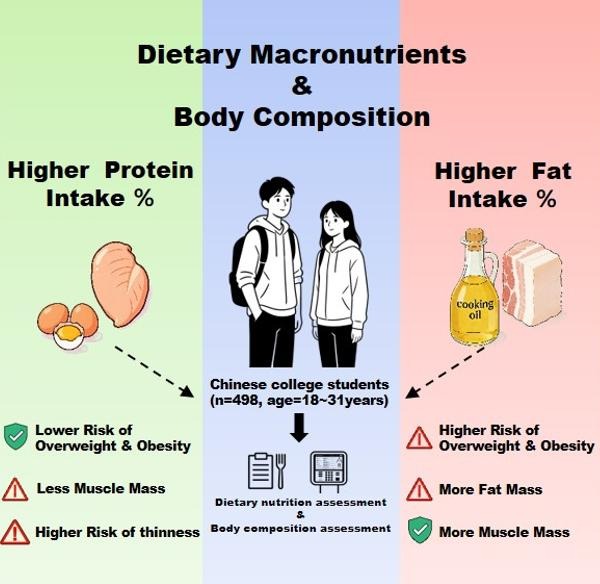
Association between dietary macronutrients and body composition in college students

Author : Huini Ding, Yuhui Sun, Wenjing Wang, Yijia Liu, Yuning Jiao, Wangziyan Lu, Yuandi Xi
Keyword : cross-sectional study, body composition, carbohydrate, fat, protein
Content : Background and Objectives: Evidence regarding macronutrients and body composition remains limited. This study examined the relationship in Chinese college students. Methods and Study Design: 498 Beijing college students aged 18–31 years were included. Dietary intake was assessed using a food frequency questionnaire, and body composition was measured by bioelectrical impedance. Linear and logistic regression analyses examined correlations between macronutrients intake and body composition.
15

The association between family economic status and nutrient intake among preschool children attending nursery schools in Japan

Author : Atsuki Sakai, Katsushi Yoshita, Takako Takahashi, Tetsuko Okabe, Ruriko Sasaki, Hiromi Ishida, Hiromitsu Ogata, Aya Abe, Mitsuhiko Hara, Yukiko Yoshiok, Miho Nozue, Tatsuaki Sakamoto, Sanae Ito, Nobuko Murayama
Keyword : nursery school, preschool children, nutrient intakes, equivalent income, DRIs for Japanese
Content : Background and Objectives: This cross-sectional study investigated the association between equivalent income and energy and nutrient intake among nursery school children. Methods and Study Design: A total of 761 preschool children aged 3 to 6 years participated. Energy and nutrient intakes were calculated using four-day food records consisting of two non-consecutive weekdays and two non-consecutive weekend days, collected between October and December in 2019 and 2020. Equivalent income was calculated by dividing household income by the square root of the number of household members. Nutrient inadequacy was evaluated using the DRIs for Japanese (2020). Analysis of covariance was used to compare intakes among equivalent income groups, and χ2 tests were used to compare the prevalence of...
16

Association between ultra-processed food exposure and gestational diabetes mellitus by diet balance index for pregnancy in Chinese women

Author : Wen Liu, Ziqi Wang, Tao Wu, Qian Zhang, Jianbo Zhou
Keyword : gestational diabetes mellitus, ultra-processed foods, Chinese Diet Balance Index for Pregnancy, oral glucose tolerance test, retrospective cohort study
Content : Background and Objectives: This study aims to investigate the impact of ultra-processed food (UPF) intake and the Chinese Diet Balance Index for Pregnancy (DBI-P) index on cesarean section rates and neonatal weight among women with gestational diabetes mellitus (GDM). Methods and Study Design: This study was a retrospective cohort study involving 279 GDM patients. We have collected dietary data, pregnancy information, and calculated UPF intake and the Chinese Diet Balance Index for Pregnancy (DBI-P) index. The impact of UPF exposure and dietary factors on low birth weight and macrosomia was analyzed using logistic regression.
17

Triglyceride glucose-body mass index as a practical screening tool for metabolic dysfunction-associated steatotic liver disease in older adults: A community-based cohort study

Author : Ying Jiang, Weiqi Hong, Tianwei Xu, Jialu Wang, Molian Tang, Qin Cao, Yun Li, Renying Xu
Keyword : TyG index, obesity, metabolic dysfunction-associated steatotic liver disease, aged population, time-dependent ROC analysis
Content : Background and Objectives: As the prevalence of metabolic dysfunction-associated steatotic liver disease (MASLD) rises, identifying reliable biomarkers for risk prediction is essential. This study assessed baseline triglyceride glucose (TyG) index and TyG-derived parameters as predictors of future MASLD risk in older adults. Methods and Study Design: We analyzed data from 2,757 Chinese adults (60-91 years) undergoing annual health checks (2017-2023). Incident MASLD was detected using ultrasound after excluding baseline cases. Cox proportional hazards models (with parameters in quartiles) and time-dependent ROC curves quantified associations and time-varying predictive performance among TyG-related parameters. The predictive performance of TyG-BMI was also compared with the hepatic ste...
18

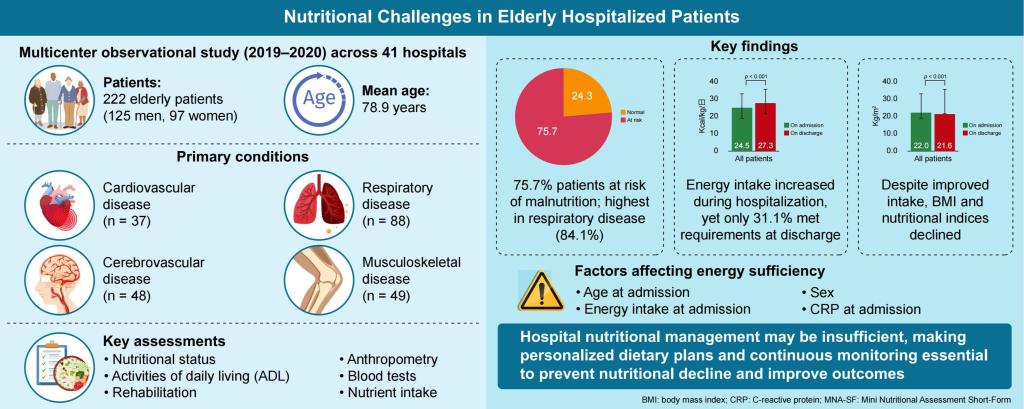
Energy intake and nutritional status in older adults undergoing long-term rehabilitation for chronic diseases: A multicentre prospective study

Author : Takahiro Yamamoto, Kenichiro Yasutake, Shoji Ando, Akiko Toriyama, Masayuki Nishida, Atsushi Moriwaki
Keyword : malnutrition, energy intake, protein intake, rehabilitation nutrition, nutrition management
Content : Background and Objectives: In this multicentre prospective observational study, we aimed to investigate changes in energy intake and nutritional indices, including cardiovascular, cerebrovascular, respiratory, and musculoskeletal conditions, among older adults hospitalised in general hospitals who required long-term rehabilitation. Methods and Study Design: This study included patients aged ≥65 years who were admitted to 41 National Hospital Organization hospitals between September 2019 and March 2020 with cardiovascular, cerebrovascular, respiratory, or musculoskeletal diseases. Physical measurements, blood test values, energy intake, and activities of daily living were evaluated at admission and discharge
Copyright  APJCN. All rights reserved.